As an Amazon Associate I earn from qualifying purchases. Fine Edit Home may also earn a commission through other links in this article, at no additional cost to you. Prices and availability can change.
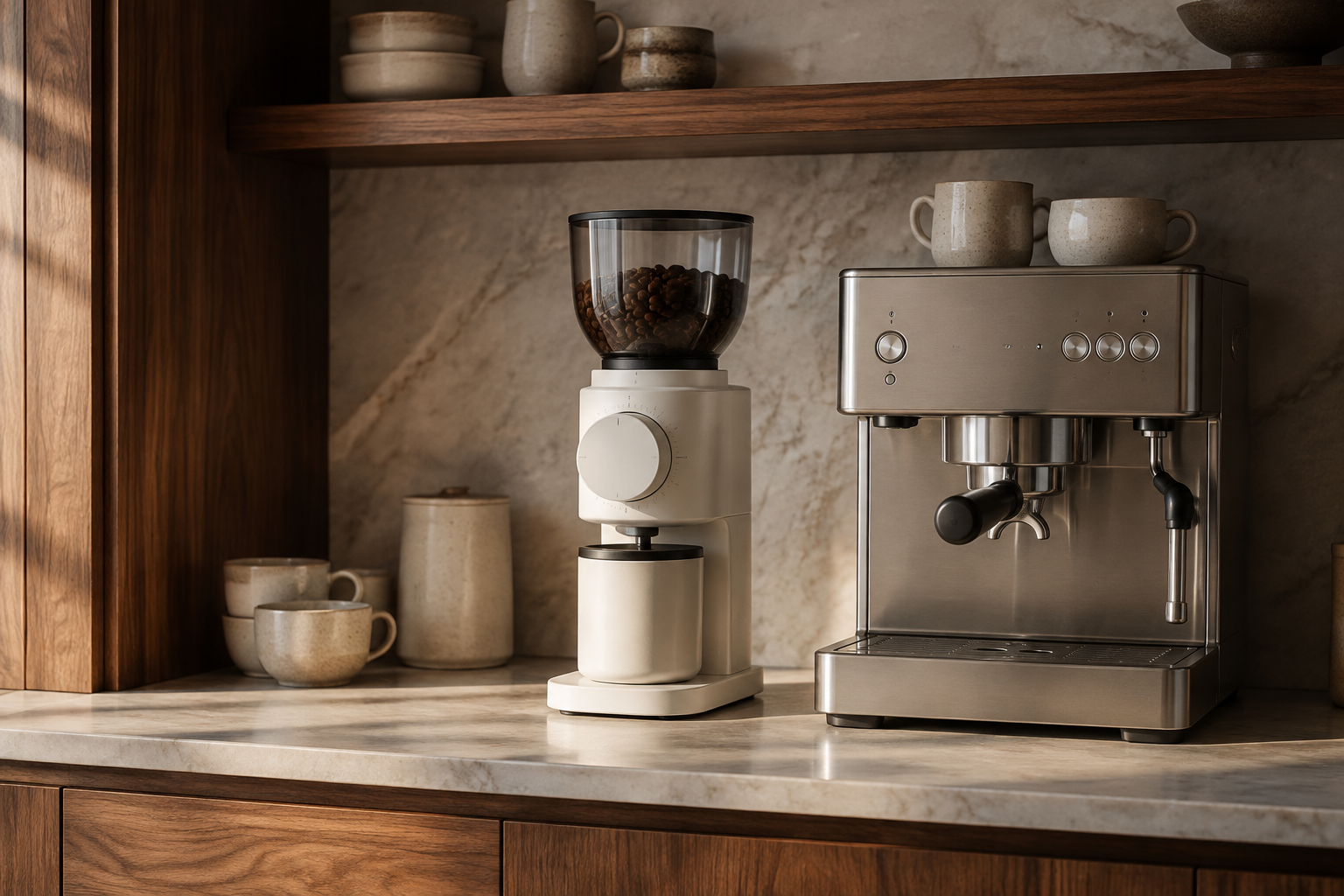
A beautiful espresso machine deserves a grinder that can do more than simply look good beside it. The best coffee grinder for espresso must make tiny, repeatable adjustments, keep the morning routine manageable, and earn its place on the counter. The four models below balance espresso performance with the clean, considered design that suits a refined home coffee bar.
The Quick Edit
Best overall for most homes: the Fellow Opus 2 is compact, versatile, and design-forward. Choose the Baratza Encore ESP for an approachable first espresso grinder, the Breville Smart Grinder Pro for convenient timed dosing, or the Niche Zero for a premium single-dose workflow.
| Grinder | Best for | Adjustment | Counter style |
|---|---|---|---|
| Fellow Opus 2 | Best overall | Stepless | Compact and sculptural |
| Baratza Encore ESP | Espresso beginners | Stepped | Simple and practical |
| Breville Smart Grinder Pro | Programmable convenience | 60 settings | Polished appliance look |
| Niche Zero | Premium single dosing | Stepless | Minimal with oak accents |
1. Fellow Opus 2 — Best Overall for a Beautiful Coffee Bar
The updated Fellow Opus 2 is the easiest recommendation for a kitchen where performance and visual calm matter equally. Its slim, softly geometric body looks at home against warm wood, creamy stone, or minimalist cabinetry, while the 48 mm stainless-steel conical burrs cover the full range from espresso to cold brew.
A stepless side dial makes small espresso adjustments more intuitive than the nested system used by the original Opus. Fellow also designed the grinder for near-zero retention and added an anti-static ionizer to help control mess. The included espresso dosing cup works with both 54 mm and 58 mm portafilters, which is especially useful if you own a compact Breville machine now but may upgrade later.
- Why we like it: attractive, compact, quiet-looking on the counter, and useful for more than espresso
- Best for: a design-conscious home that alternates between espresso and other brew methods
- Consider: the 100-gram capacity is better suited to thoughtful home use than high-volume entertaining
2. Baratza Encore ESP — Best First Espresso Grinder
The Encore ESP takes the familiar simplicity of Baratza’s entry-level grinder and gives the fine end of the adjustment range the extra resolution espresso requires. Turn the hopper to change the grind, press the pulse button, and use the included dosing cup to transfer grounds cleanly. It is intentionally straightforward, making it a smart companion for someone learning to dial in espresso without adding a complicated screen or menu.
At about $199.95 on Baratza’s U.S. site at the time of writing, it sits in the approachable part of the espresso-grinder market. Its silhouette is more practical than decorative, but the clean black or white body blends easily into an edited kitchen.
- Why we like it: simple workflow, espresso-focused adjustment, included dosing cup
- Best for: first-time espresso owners and smaller budgets
- Consider: stepped settings are easy to repeat but offer less micro-adjustment than a stepless dial
3. Breville Smart Grinder Pro — Best for Programmable Convenience
If your ideal morning routine is measured and repeatable, the Smart Grinder Pro makes sense. Breville combines 60 grind settings with Dosing IQ, allowing grind time to be adjusted in 0.2-second increments. The LCD display keeps the chosen setting, grind time, and shot or cup count visible, and the grinder can dispense directly into a portafilter or container.
The stainless-steel housing pairs naturally with many Breville espresso machines, and the box includes cradles for 50–54 mm and 58 mm portafilters. At 15.3 inches high, it has a taller hopper profile than the Fellow or Niche, so measure beneath upper cabinets before ordering. Breville listed it at about $199.95 at the time of writing, though stock may vary.
- Why we like it: repeatable timed dosing and a clear display
- Best for: households that keep one everyday bean in the hopper
- Consider: changing beans is less convenient than with a single-dose grinder
4. Niche Zero — Best Premium Single-Dose Grinder
The Niche Zero has become a design reference for home espresso grinders because its workflow is as calm as its appearance. Weigh one dose of beans, grind it, and move on—without leaving a hopper full of coffee to age. Its 63 mm conical burrs, infinite stepless dial, and low-retention design make it easy to move between beans or brew methods.
The aluminum body and real oak trim are particularly well suited to an organic-modern kitchen. It is also relatively compact at roughly 12.2 inches high with the lid closed. Niche sells the grinder directly in several plug configurations, including a U.S. 110V option; price and availability depend on region.
- Why we like it: beautiful proportions, quiet single-dose ritual, precise stepless adjustment
- Best for: enthusiasts who change beans often and value low retention
- Consider: it costs considerably more than the entry-level choices and requires weighing each dose
How to Choose the Best Coffee Grinder for Espresso
Stepped or stepless adjustment
A stepped grinder clicks between fixed settings. It is easy to remember and repeat, which makes it friendly for beginners. A stepless grinder moves continuously, letting you make extremely small changes when a shot runs a few seconds too fast or too slow. The extra control is valuable for espresso, but it asks for a little more patience.
Single dose or hopper
Single dosing means weighing only the beans needed for one drink. It keeps beans fresher and makes switching coffees simple. A hopper is faster when everyone in the house drinks the same coffee every day. Choose the routine you will actually enjoy rather than the workflow that sounds most advanced.
Portafilter compatibility
Many compact home espresso machines use a 54 mm portafilter; traditional prosumer machines often use 58 mm. A compatible dosing cup or cradle prevents loose grounds and makes the counter easier to keep clean.
Height, depth, and visual weight
Measure the space beneath your upper cabinets with the hopper lid open, not only closed. In a small coffee station, a grinder with a compact base and restrained color can feel far less imposing. For more layout ideas, see our guide to beautiful home coffee stations.
The Fine Edit
For most homes, the Fellow Opus 2 offers the most convincing balance of espresso control, compact scale, and counter-worthy design. The Baratza Encore ESP is the sensible starting point; the Breville Smart Grinder Pro prioritizes convenience; and the Niche Zero is the elevated choice for someone who wants single-dose precision. Whichever you choose, the grinder matters at least as much as the espresso machine: fresh, evenly ground coffee is what turns a beautiful setup into a genuinely satisfying daily ritual.
Frequently Asked Questions
Do I need a special grinder for espresso?
Yes. Espresso needs a very fine, consistent grind and small adjustments to control extraction time. A general blade grinder cannot provide that precision.
Is a more expensive grinder worth it?
It can be if you make espresso often. Premium grinders typically offer more precise adjustment, better consistency, lower retention, quieter operation, or a more durable build. Beginners can still make excellent coffee with the Encore ESP or Opus 2.
Should I leave coffee beans in the hopper?
You can for convenience, but beans stay fresher in an airtight container away from heat and light. Single dosing is preferable if you switch coffees frequently or want to measure every shot precisely.
Leave a Reply